
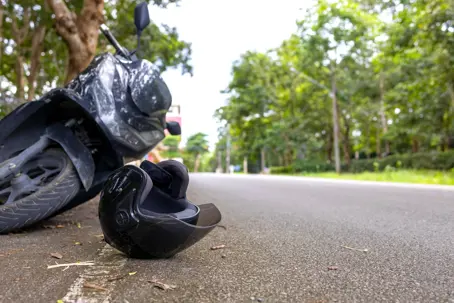
Motorcycle crashes are among the most devastating accidents on South Carolina roads. According to the National Highway Traffic Safety Administration (NHTSA), 6,335 motorcyclists died in traffic crashes across the United States in 2023. That same year, an estimated 82,564 riders suffered injuries. These numbers are staggering when you consider that motorcycles make up less than one percent of all vehicle miles traveled.
South Carolina is one of the most dangerous states for motorcyclists. The South Carolina Department of Public Safety (SCDPS) reported 161 motorcycle fatalities on state roadways in 2021 alone. Per vehicle mile traveled, motorcyclists are 29 times more likely to die in a crash than passenger car occupants. They are also five times more likely to suffer serious injuries.
Understanding the types of injuries that motorcycle crashes cause helps riders know what to expect after an accident. It also helps victims build stronger personal injury claims. This guide covers the most common motorcycle crash injuries in South Carolina and explains your legal rights if another driver caused your accident.
Traumatic Brain Injuries
Head injuries are the leading cause of death in motorcycle crashes. The NHTSA’s study on motorcycle helmet use found that 15 percent of helmeted motorcyclists suffered traumatic brain injury (TBI). That number climbed to 21 percent for unhelmeted riders. Even more alarming, TBI accounted for 54 percent of motorcycle fatalities in the study group.
A TBI occurs when a sudden blow or jolt to the head disrupts normal brain function. The severity ranges widely. Mild cases involve concussions that may heal with rest. Severe cases can cause lasting cognitive problems, memory loss, personality changes, seizures, and permanent disability. Some victims never regain full brain function.
Concussions are the most common form of mild TBI. However, diffuse axonal injuries, where nerve fibers in the brain tear from violent movement, can be far more destructive. A coup-contrecoup injury happens when the brain strikes the inside of the skull on both sides after a forceful impact. Each type requires different treatment and carries its own long-term risks.
South Carolina only requires helmets for riders and passengers under the age of 21 under S.C. Code § 56-5-3660. Riders 21 and older may legally ride without a helmet. However, the absence of a helmet dramatically increases the risk of a fatal or severe brain injury in any crash.
Importantly, the South Carolina Supreme Court has ruled that not wearing a helmet does not reduce an injured rider’s legal claim. In Mayes v. Paxton, 313 S.C. 109, 437 S.E.2d 66 (1993), the Court struck the defenses of contributory negligence and assumption of risk based on the plaintiff’s failure to wear a helmet. The Court held:
“As a matter of law, we find that a motorcyclist’s decision to ride without a helmet does not imply his consent that motorists are relieved of the duty to use reasonable care toward him.”
Mayes, 313 S.C. at 113, 437 S.E.2d at 68.
The Court further reasoned that because the legislature chose not to extend the helmet requirement to riders over 21, courts would not create a judicial penalty for those riders. The Court stated: “[W]e decline to create a judicial penalty for those exempted from the statutory duty.” Id. The Court cited Keaton v. Pearson, 292 S.C. 579, 358 S.E.2d 141 (1987), where it had similarly refused to impose a duty to wear seatbelts when no statute required them. Together, these cases make clear that insurance companies cannot reduce your compensation based on your legal choice not to wear a helmet.
Spinal Cord Injuries
The violent forces in a motorcycle crash can fracture, compress, or sever the spinal cord. According to research published by the National Institutes of Health (NIH), spinal cord injuries occur in approximately two percent of fatal motorcycle crashes. While that percentage sounds small, the consequences are life-altering.
An injury to the lower spinal cord can cause paraplegia, which is paralysis of the legs and lower body. Damage higher up in the neck region can cause quadriplegia, affecting both arms and legs. Either condition requires extensive medical care, rehabilitation, and adaptive equipment for daily living. Many victims need lifelong assistance with basic tasks.
The South Carolina Supreme Court addressed a devastating motorcycle spinal cord injury in Oliver v. South Carolina Department of Highways & Public Transportation, 309 S.C. 313, 422 S.E.2d 128 (1992). In that case, a motorcyclist struck a vehicle that was parked in a highway right-of-way. The impact caused a “deceleration type” injury to the rider’s spinal cord, resulting in total and permanent paraplegia. The Court upheld the jury’s finding that the highway department’s negligence was the proximate cause of the rider’s catastrophic injuries, reaffirming the standard for proximate cause:
“Proximate cause requires proof of both causation in fact, and legal cause. Causation in fact is proved by establishing the injury would not have occurred ‘but for’ the defendant’s negligence.”
Oliver, 309 S.C. at 317, 422 S.E.2d at 131 (quoting Whitlaw v. Kroger Co., 306 S.C. 51, 410 S.E.2d 251, 253 (1991)).
The Court further held that “[l]egal cause is proved by establishing foreseeability,” and that it was foreseeable a vehicle parked in the right-of-way could cause a collision with a motorcyclist. Id. There had been three prior accidents involving parked cars at that same location. The Oliver case demonstrates how courts hold negligent parties fully accountable for the catastrophic scope of spinal cord injuries, including permanent paralysis and its devastating lifetime costs.
Earlier, in Young v. Warr, 252 S.C. 179, 165 S.E.2d 797 (1969), the Supreme Court recognized that a paraplegic’s loss of social and business activities constitutes a compensable intangible injury. This means victims with paralysis can recover not only for medical expenses but also for the activities and life experiences they can no longer enjoy.
The financial burden of a spinal cord injury is enormous. Ongoing medical treatment, physical therapy, home modifications, assistive devices, and full-time care can run into the millions of dollars over a lifetime. South Carolina law allows victims to recover both past and future medical expenses from the at-fault driver.
Lower Extremity Injuries
Legs, feet, ankles, and knees absorb tremendous impact in a motorcycle crash. NHTSA research confirms that lower extremity injuries are the most common non-fatal injuries motorcyclists sustain. A rider’s legs are exposed and often the first point of contact with the ground, another vehicle, or road debris.
Common lower extremity injuries include fractured femurs, shattered tibias, crushed ankles, and torn ligaments in the knee. The motorcycle itself can fall on the rider’s leg, pinning it to the pavement. In severe cases, the damage is so extensive that amputation becomes necessary.
Recovery from these injuries is often long and painful. Multiple surgeries, months of physical therapy, and permanent hardware like rods and screws are common. Many victims cannot return to their previous jobs or physical activities. The loss of earning capacity and diminished quality of life are significant elements of a personal injury claim.
Road Rash
When a rider slides across the pavement after being thrown from a motorcycle, the friction tears away layers of skin. This injury is known as road rash. The severity depends on the speed of the slide, the type of road surface, and the clothing the rider was wearing.
Mild road rash resembles a scrape or abrasion that heals on its own. Moderate cases involve deeper layers of skin and require professional medical treatment. Severe road rash strips away skin, fat, and even muscle tissue down to the bone. These cases often require skin grafts, leave permanent scarring, and carry a high risk of serious infection.
Thick protective clothing like leather jackets, riding pants, and gloves can reduce the severity of road rash. However, no clothing completely eliminates the risk during a high-speed slide. Victims with severe road rash may face disfigurement that affects their appearance and self-confidence for the rest of their lives. South Carolina law allows recovery for both the physical pain and the emotional distress that disfigurement causes.
Broken Bones and Fractures
The force of a motorcycle collision can break nearly any bone in the body. Arms, wrists, collarbones, ribs, and pelvis fractures are all extremely common. Riders instinctively extend their arms to brace for impact, which often results in fractured wrists and forearms. A direct hit to the chest can crack ribs and potentially puncture a lung.
Compound fractures, where the bone breaks through the skin, are particularly dangerous. They require immediate surgery and carry a significant risk of infection. Even simple fractures may need surgical repair with plates, screws, or pins. Healing takes weeks to months, and some fractures never fully restore the bone’s original strength.
Rib fractures deserve special attention. Beyond the pain they cause, broken ribs can damage internal organs like the lungs, liver, or spleen. A punctured lung can become a life-threatening emergency if not treated quickly. Any chest pain after a motorcycle crash warrants immediate medical evaluation.
Internal Injuries
Blunt force trauma from a motorcycle crash can damage internal organs without leaving visible wounds on the outside of the body. The liver, spleen, kidneys, and lungs are all vulnerable to impact injuries. Internal bleeding can be slow and subtle, making it one of the most dangerous types of motorcycle crash injuries.
Symptoms of internal injuries may not appear for hours or even days after the accident. A rider may feel fine immediately after the crash, only to collapse later from internal bleeding. This is why seeking medical attention right away is so critical. Emergency room doctors use imaging like CT scans and ultrasounds to detect internal damage that a physical exam alone might miss.
Surgery is often required to repair damaged organs and stop internal bleeding. Recovery can take weeks in the hospital followed by months of restricted activity. The delayed onset of symptoms makes it vital to document your medical treatment from the very first visit. Learn more about protecting your claim in our guide on steps to take at an accident scene.
Emotional Trauma and PTSD
The physical injuries from a motorcycle crash are only part of the picture. Many survivors experience profound emotional and psychological harm. Post-traumatic stress disorder (PTSD) is common among motorcycle crash victims. Flashbacks, nightmares, severe anxiety, and a deep fear of riding again can persist for months or years after the accident.
Depression often accompanies serious injuries, especially when a rider faces a long recovery or permanent disability. The inability to work, participate in hobbies, or enjoy daily life takes a heavy emotional toll. Relationships with family and friends may suffer as the victim struggles to cope.
South Carolina law recognizes emotional distress as a compensable injury. You can claim damages for PTSD, anxiety, depression, and loss of enjoyment of life alongside your physical injury claim. Documenting your emotional symptoms through therapy records and mental health treatment strengthens this part of your case.
Recovering Damages for Pain, Suffering, and Loss of Enjoyment of Life
Every motorcycle crash injury brings pain. Some injuries cause chronic pain that lasts for years or a lifetime. South Carolina law allows injured riders to recover compensation for this suffering. The South Carolina Supreme Court addressed the nature of these damages in Edwards v. Lawton, 244 S.C. 276, 136 S.E.2d 708 (1964), stating:
“Pain and suffering have no market price. They are not capable of being exactly and accurately determined, and there is no fixed rule or standard whereby damages for them can be measured. Hence, the amount of damages to be awarded for pain and suffering must be left to the judgment of the jury.”
Edwards, 244 S.C. at 281, 136 S.E.2d at 710.
Beyond pain and suffering, motorcycle crash victims often lose the ability to participate in activities they once enjoyed. The Supreme Court addressed this separately in Boan v. Blackwell, 343 S.C. 498, 541 S.E.2d 242 (2001), holding:
“Where there is evidence of ‘loss of enjoyment of life,’ South Carolina juries should be charged that this loss is a compensable element, separate and apart from pain and suffering, of a damages award.”
Boan, 343 S.C. at 502, 541 S.E.2d at 244.
This ruling is especially powerful for motorcycle crash victims. A rider who suffers a spinal cord injury and can never ride again has lost far more than the ability to work. A victim with a severe TBI who cannot remember family milestones has suffered a profound loss of enjoyment. Under Boan, these losses are compensable as a distinct category of damages. The jury must be specifically instructed to consider them. This separate charge helps ensure that victims are not undercompensated for the full scope of how the crash changed their lives.
The Court in Boan built on earlier precedent, citing Young v. Warr, 252 S.C. 179, 165 S.E.2d 797 (1969), where the Court recognized that a paraplegic’s loss of social and business activities is a compensable intangible injury, and Cabler v. L.V. Hart, Inc., 251 S.C. 576, 164 S.E.2d 574 (1968), where the Court held it was proper to consider how injuries “decrease and diminish the joys and pleasures of a normal life.” Boan, 343 S.C. at 503, 541 S.E.2d at 244.
Fatal Motorcycle Crash Injuries
Some motorcycle crashes result in fatal injuries despite the best medical care. South Carolina’s wrongful death statute, S.C. Code § 15-51-10, allows surviving family members to pursue a claim for the death of a loved one. Recoverable damages include medical expenses before death, funeral and burial costs, lost future income, and loss of companionship.
The statute of limitations for wrongful death claims in South Carolina is three years from the date of death. Families should consult an attorney as soon as possible to preserve evidence and protect their legal rights during an incredibly difficult time.
Proving the Other Driver Was at Fault
Most motorcycle crashes happen because a car or truck driver failed to see the rider. Common causes include drivers making left turns across a motorcycle’s path, failing to yield at intersections, following too closely, and changing lanes without checking blind spots. Under S.C. Code § 56-5-3610, motorcyclists are entitled to all the same rights as other motor vehicle drivers. That includes the right of way, the right to the full use of a lane under S.C. Code § 56-5-3640, and the right to expect other drivers to exercise reasonable care.
When a driver violates a traffic law and causes your crash, that violation may establish negligence as a matter of law. The foundation for this doctrine was laid in Field v. Gregory, 230 S.C. 39, 94 S.E.2d 15 (1956), where the South Carolina Supreme Court stated:
“The violation of an applicable statute is negligence per se, and whether or not such breach contributed as a proximate cause to [the] plaintiff’s injury is ordinarily a question for the jury.”
Field, 230 S.C. at 44, 94 S.E.2d at 18.
The Court in Field went further, observing that “[c]ausative violation of an applicable statute constitutes actionable negligence and is evidence of recklessness, willfulness and wantonness.” Id. at 46, 94 S.E.2d at 19. This language is critical for motorcycle crash victims because it opens the door to potential punitive damages when the conduct is egregious enough.
Decades later, the Supreme Court reaffirmed and expanded this principle in Wise v. Broadway, 315 S.C. 273, 433 S.E.2d 857 (1993), holding:
“The causative violation of a statute constitutes negligence per se and is evidence of recklessness and willfulness, requiring the submission of the issue of punitive damages to the jury.”
Wise, 315 S.C. at 276, 433 S.E.2d at 859.
The Court in Wise clarified an important distinction. A statutory violation constitutes negligence per se, meaning negligence is established as a matter of law. However, it is only “evidence of recklessness” and not recklessness per se. Id. at 277, 433 S.E.2d at 860. This means the jury can still decide that a traffic violation, while negligent, did not rise to the level of reckless conduct. The violation creates a jury question on punitive damages, but does not guarantee them.
Most recently, the Court confirmed this unbroken line of precedent in Fairchild v. South Carolina Department of Transportation, 398 S.C. 110, 727 S.E.2d 407 (2012). The Court held that “the violation of a statute constitutes negligence per se, and negligence per se is some evidence of recklessness and willfulness.” Fairchild, 398 S.C. at 118, 727 S.E.2d at 411 (citing Wise v. Broadway). In that case, the defendant was driving a commercial truck with a combined weight exceeding eight and one-half tons. He failed to reduce speed when approaching heavy traffic and an area “where a lot of accidents happen.” Id. at 120, 727 S.E.2d at 412. The Court reversed the trial court’s directed verdict on punitive damages and sent the issue back to the jury.
For motorcycle crash victims, this means a driver who ran a red light, failed to yield, or was texting when they hit you has already been proven negligent by the statute violation itself. You still need to prove causation and damages, but the legal burden becomes significantly lighter. Read more about how this applies in our article on types of negligence in South Carolina.
How Shared Fault Affects Your Motorcycle Claim
South Carolina follows a modified comparative negligence rule. The Supreme Court adopted this system in Nelson v. Concrete Supply Co., 303 S.C. 243, 399 S.E.2d 783 (1991), holding:
“[A] plaintiff in a negligence action may recover damages if his or her negligence is not greater than that of the defendant. The amount of the plaintiff’s recovery shall be reduced in proportion to the amount of his or her negligence.”
Nelson, 303 S.C. at 245, 399 S.E.2d at 784.
This rule is now codified at S.C. Code § 15-38-15. If you are 50 percent or less at fault, your recovery is reduced by your fault percentage. If you are 51 percent or more at fault, you are barred from recovering any compensation at all.
Insurance companies regularly try to shift blame onto motorcycle riders. They may argue you were speeding, following too closely, or lane splitting in violation of S.C. Code § 56-5-3640, which prohibits riding between lanes of traffic. An experienced attorney can counter these tactics with evidence that shows the other driver caused the crash. For insight on how insurers operate, see our article on the role of insurance companies in auto accident cases.
Will Not Wearing a Helmet Reduce My Compensation?
This is one of the most important questions for South Carolina motorcycle riders. The answer comes directly from the Supreme Court’s decision in Mayes v. Paxton, 313 S.C. 109, 437 S.E.2d 66 (1993). The Court held that a rider over 21 who chooses not to wear a helmet is not negligent for that choice. The Court stated:
“It is undisputed that Mayes had no statutory duty to wear a helmet at the time of the accident. [Section] 56-5-3660 (1991) requires the use of a helmet by motorcycle operators and passengers under the age of twenty-one, [and] Mayes was excluded from that duty because he was more than twenty-one years old when the accident occurred.”
Mayes, 313 S.C. at 113, 437 S.E.2d at 68.
The Court also rejected the assumption of risk defense. Citing Hoeffner v. The Citadel, the Court explained that assumption of risk requires showing the plaintiff “understood and appreciated a known danger created by the defendant, and then freely and voluntarily exposed himself to it.” Mayes, 313 S.C. at 113, 437 S.E.2d at 68 (citing Hoeffner, 429 S.E.2d 190, 193 (1993)). The Court held that choosing to ride without a helmet “does not imply his consent that motorists are relieved of the duty to use reasonable care toward him.” Id.
This means the at-fault driver is responsible for the full extent of your injuries, regardless of whether you chose to wear a helmet. Insurance adjusters may still try to argue the point, but South Carolina law is squarely on your side.
Time Limits for Filing Your Claim
South Carolina gives you three years from the date of your motorcycle accident to file a personal injury lawsuit under S.C. Code § 15-3-530. Missing this deadline permanently bars your claim. Claims against government entities have a shorter two-year window under the South Carolina Tort Claims Act.
Three years may seem like plenty of time. However, evidence disappears, witnesses forget details, and medical records become harder to connect to the accident as time passes. Acting quickly protects the strength of your case. Filing a police report creates a critical piece of early evidence. Learn why in our guide about what happens if you don’t file a police report after an accident.
Insurance Coverage and Motorcycle Accidents
South Carolina requires all drivers to carry minimum liability insurance of $25,000 per person and $50,000 per accident for bodily injury under S.C. Code § 38-77-140. These minimums apply to motorcycle riders as well. However, motorcycle crash injuries are often catastrophic. A single TBI or spinal cord injury can generate medical bills that far exceed the at-fault driver’s policy limits.
Uninsured and underinsured motorist (UM/UIM) coverage provides an additional safety net. South Carolina requires drivers to carry UM/UIM coverage at the same minimum amounts as their liability policy. This coverage protects you when the at-fault driver has no insurance or not enough to cover your losses. Understanding your own policy is essential. Learn more in our article about full coverage car insurance in South Carolina.
Steps to Protect Your Claim After a Motorcycle Crash
The actions you take immediately after a crash directly affect the outcome of your case. Call 911 and request police response. Get medical attention right away, even if you feel fine. Many serious injuries like TBI and internal bleeding do not show symptoms immediately.
Document everything at the scene. Take photos of the damage to your motorcycle, the other vehicle, the road conditions, and your injuries. Get contact information from any witnesses. Ask the responding officers how to obtain a copy of the police report.
Do not give a recorded statement to the other driver’s insurance company without speaking to a lawyer first. Avoid admitting any fault at the scene. Even casual statements like “I didn’t see them” can be used against you later. Focus on getting treatment and let an attorney handle the legal strategy. Read more about distracted driver negligence and your legal rights.
Contact Klok Law Firm LLC
Motorcycle crashes cause some of the most serious injuries on South Carolina roads. From traumatic brain injuries and spinal cord damage to shattered bones and severe road rash, the physical, emotional, and financial toll can be devastating. As the Supreme Court confirmed in Mayes v. Paxton, your choice not to wear a helmet does not reduce your right to full compensation. Under Wise v. Broadway, Field v. Gregory, and Fairchild, a driver who violated a traffic law and caused your crash is negligent per se. As Oliver demonstrates, courts hold negligent parties fully accountable for catastrophic motorcycle injuries including permanent paralysis. And under Boan v. Blackwell, your loss of enjoyment of life is a separately compensable element of damages that goes beyond pain and suffering.
At Klok Law Firm LLC, we represent motorcycle crash victims in Charleston, Mount Pleasant, and throughout the South Carolina Lowcountry. We understand the unique challenges riders face after a crash. We fight against insurance company tactics that try to blame the rider and minimize your claim.
Call us today at (843) 701-1695 or contact us online to schedule a free consultation. Let us handle the legal fight while you focus on your recovery.
This blog post is for informational purposes only and does not constitute legal advice. Each case involves unique circumstances that require consultation with a qualified attorney. For specific guidance on your motorcycle accident claim, contact an experienced South Carolina personal injury lawyer.