

A Tool for Preserving Legally Admissible Child Statements in South Carolina Family Court
IMPORTANT LEGAL NOTICE: This tool is designed to assist parents in compiling detailed factual documentation to assist their legal counsel. It does not constitute legal advice. In South Carolina family law, child hearsay is highly technical and strictly regulated under S.C. Code § 19-1-180 and SCRE Rules. Direct all compiled logs and materials to a licensed attorney to determine courtroom admissibility.
Section 1: The Admissibility Framework & The 'Parent Trap'
In South Carolina family court, a child's out-of-court statement regarding abuse or neglect is legally classified as hearsay. Hearsay is generally inadmissible because the child cannot be cross-examined in court. However, South Carolina law provides specific statutory exceptions—most notably S.C. Code § 19-1- 180—to allow a child's voice to be heard. Despite this exception, parents face a major hurdle known as The Parent Trap (S.C. Code § 19-1-180(G)).
Under Section 19-1-180(G), if the parents are separated or divorced, a child's out-of-court statements made to a parent are strictly inadmissible if: (1) the other parent is the alleged abuser, and (2) the allegations arose post-separation. This rule prevents parents from testifying about what their child told them due to the high risk of parental coaching. To bypass this barrier, parents must direct their child to qualified, neutral professionals immediately upon disclosure. Statements made to these professionals remain admissible under the law.
Under South Carolina law, statements made to the following qualified professionals preserve admissibility:
- Licensed family counselors, therapists, or psychologists: Highly favored by courts under SCRE 803(4) for medical/mental health diagnosis (supported by Glinyanay v. Tobias, 2022).
- Physicians, pediatricians, or medical health care providers: Statements made to medical providers for diagnosing injuries or physical symptoms.
- Teachers or school counselors: Neutral school personnel who can testify to disclosures made in a safe, academic setting. •
- Department of Social Services (DSS) staff members: Caseworkers and investigators responding to abuse or neglect reports.
- Law enforcement officers or investigators: Police officers, forensic interviewers, or school resource officers. •
- Child care workers at regulated facilities: Daycare teachers, directors, or after-school program leaders.
To ensure statements to these professionals are successfully admitted, parents must carefully track all professional consultations, maintain meticulous records of what was observed, and document the child's verbatim words when disclosures occur.
Section 2: Professional Contact & Consultation Log
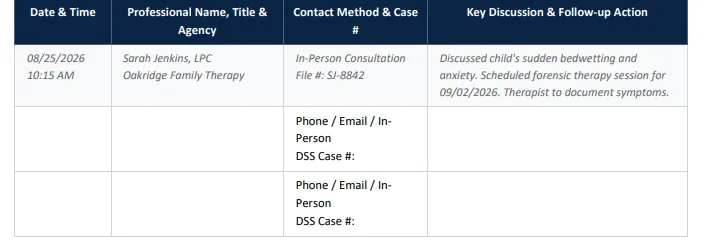
Use this log to record every contact with school counselors, teachers, DSS caseworkers, physicians, and therapists. This creates an auditable record of prompt, non-investigative parent action and helps your attorney secure necessary testimony or records from these professionals.
Section 3: Child Hearsay Disclosure Log (Verbatim)
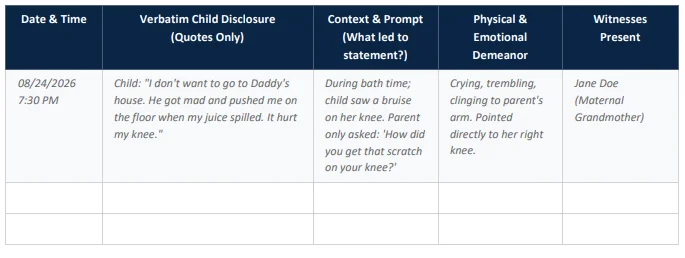
To establish 'particularized guarantees of trustworthiness,' you must prove that statements were spontaneous, not coached, and made in age-appropriate language. Record disclosures immediately after they occur. Never record your child or interrogate them; instead, write down their spontaneous disclosures exactly as spoken.
Section 4: Photographic & Physical Evidence Log
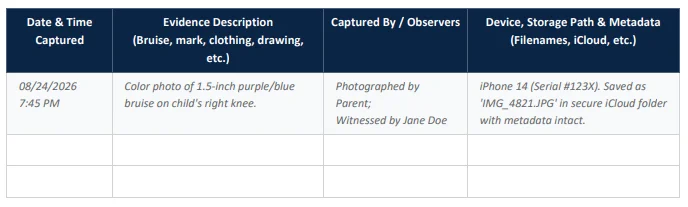
Corroborating physical evidence—such as visible bruises, red marks, torn clothing, or illustrative drawings made by the child—is critical to establishing the trustworthiness of hearsay statements. Use this log to track how physical or photographic evidence was captured, ensuring proper custody and metadata preservation for court.
Section 5: Procedural Checklist & Legal Notice Requirements
South Carolina law imposes strict procedural requirements that, if missed, will bar your child's statement from court regardless of its trustworthiness. Work with your attorney to check off each requirement:
- [ ] Advance Written Notice (S.C. Code § 19-1-180(C)): You must notify the opposing party in writing of your intent to offer the child's statement sufficiently in advance of the hearing. This notice must contain the substance of the statement and identify the professional or person who heard it.
- [ ] Preliminary Trustworthiness Hearing: The judge will hold a pre-trial hearing (often in chambers or during a motions hearing) to review your logs, witness testimony, and professional evaluations to rule on whether the hearsay statement is admissible.
- [ ] Evaluation of Child Availability (S.C. Code § 19-1-180(B)): If the child cannot testify, you must legally establish their 'unavailability' under the statute (e.g., due to extreme fear, potential severe emotional trauma, or communication barriers).
- [ ] Strict Compliance with Family Court Rule 23(b): Under South Carolina Family Court Rule 23(b), children should not testify about parental misconduct unless the court determines it is essential. Your attorney must strategize childtestimony pathways carefully (such as closed-circuit TV or videotaped depositions) to avoid trauma while satisfying the statute.
