
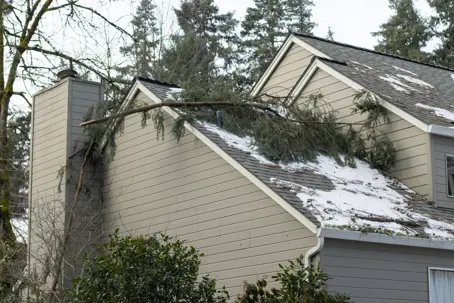
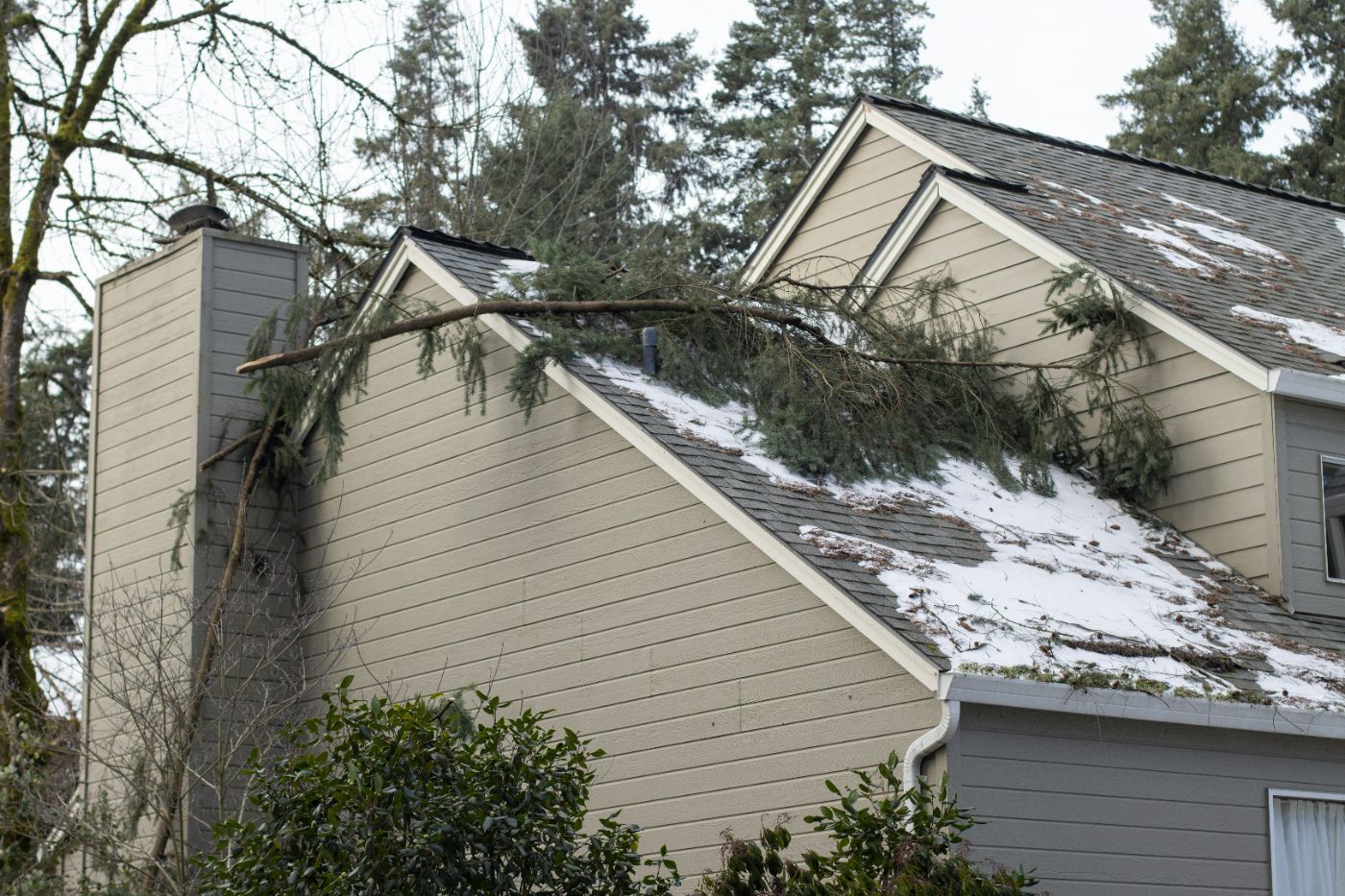
Hurricane season in the Lowcountry ends with the same phone calls every year. A live oak in the yard next door has come down across a fence, a roof or a parked car, and in the worst cases onto a person. The first thing both insurers say is “act of God.” Whether that answer holds when a tree falls on a neighbor’s property in South Carolina depends on two things: whether the tree was healthy, and where it stood.
A healthy tree brought down by a storm is nobody’s fault, and your own insurance is where the claim goes. A tree that was dead, diseased or visibly dangerous is different. South Carolina asks whether the owner knew of the danger and, for land in a developed area, whether the owner should have found it by looking. That is the question the Court of Appeals answered in a case about a dead pine on Highway 61.
The case that decides it: a dead pine on Highway 61
In Staples v. Duell, a driver heading from Charleston toward Summerville on Highway 61 in the early morning struck a dead pine tree lying in the road. The tree had come from the wooded buffer along the two-mile frontage of Middleton Place. The owner employed a caretaker who drove the perimeter twice a day looking, among other things, for dead trees. The driver sued, and the trial court ruled the owner owed her no duty. The Court of Appeals agreed.
The court explained that “in South Carolina rural landowners and urban landowners have different duties and responsibilities,” and that “South Carolina follows the traditional rural and urban distinction.” Quoting the treatise it had adopted a decade earlier, the court described the two rules: the owner of rural land “is not required to inspect it to make sure that every tree is safe,” although “if the defendant knows that the tree is dangerous, he may be required to take affirmative steps”; but “when the tree is in an urban area, and may fall into a city street, the landowner now has a duty of reasonable care, including inspection to make sure that the tree is safe,” a protection that “recent decisions have extended” to “adjoining landowners as well.”
What that means for a tree that falls on a neighbor’s property in South Carolina
In a neighborhood, the owner has to look. A lot in Mount Pleasant, West Ashley or downtown Summerville is urban land in the sense the court used. The owner of a tree there owes neighbors reasonable care, and reasonable care includes inspecting the tree. A tree that was visibly dead, hollow, leaning after a prior storm or shedding large limbs is exactly the kind of danger an inspection is supposed to catch.
On rural land, the owner has to know. For woodland and farm acreage, there is no duty to inspect, and the Court of Appeals refused to create one from constructive notice, from the commercial character of the property, or from the owner’s own habit of looking for dead trees. What can create a duty on rural land is actual knowledge that a particular tree is dangerous.
A healthy tree in a storm is nobody’s negligence. Whichever rule applies, the claim against the owner requires a danger that reasonable care would have addressed. A sound tree uprooted by hurricane-force wind does not meet that test, and the insurers’ “act of God” answer is, in that case, correct.
Where the line between rural and urban falls in a fast-growing county is decided case by case, and the court in Staples noted that the classification was the trial judge’s call. A wooded parcel on the edge of a new subdivision in Berkeley or Dorchester County is the hard case, and the facts about the tree and the surroundings decide it.
Who pays: the insurance picture
Property damage to your house from a neighbor’s tree is, in the first instance, a claim on your own homeowner’s policy, whatever the cause. Your insurer pays your loss and, if the neighbor was negligent, pursues the neighbor’s insurer for reimbursement. Where the neighbor was negligent, you may also claim directly against the neighbor’s liability coverage for what your policy does not pay, such as your deductible or an uncovered item. Removal of the tree from your land is generally your policy’s problem too, and policies vary on how much they pay for it; read yours before the debris is hauled off.
An injury changes the calculation. A limb that falls on a person walking a sidewalk, a tree that comes through a bedroom, a child hurt in a yard: those are negligence claims against the owner, paid by the owner’s homeowner’s liability coverage, and they are evaluated exactly like any other injury case. Our guide to the damages you can claim in a South Carolina personal injury case covers what those claims include, and our post on the types of negligence South Carolina recognizes explains the duty and breach the claim has to prove. Insurers treat a tree claim as a weather claim until they are shown the evidence that it was a dead-tree claim; our post on how insurance companies handle claims describes the pattern.
The evidence that turns “act of God” into a claim
- —Photograph the tree where it fell, before it is cut up, and especially the base and the break: rot, hollow trunk, fungus, dead limbs and old lean marks are the proof that the tree was a known or discoverable danger.
- —Gather the history. Prior complaints to the neighbor, texts, HOA notices, an arborist’s earlier visit or a prior limb fall are how actual knowledge is proved on any land, and how the duty to inspect is shown to have been breached in a neighborhood.
- —Get an arborist’s opinion quickly. Whether the tree was dead or diseased before the storm is a question an expert can usually answer from the stump and the wood, but only while they still exist.
- —Report the loss to your own insurer promptly and, where someone was hurt, do not give the neighbor’s insurer a recorded statement before you have spoken with a lawyer.
Your own share of the fault
Where the injured person ignored an obvious hazard, walked under a limb that had been roped off, or refused to let a neighbor remove a tree that straddled the line, the owner’s insurer will argue comparative fault. Under Nelson v. Concrete Supply Co., that reduces a recovery by the injured person’s percentage and bars it only where that share exceeds fifty percent. It is an argument, not an answer, and it is decided on the facts.
Frequently asked questions
My neighbor’s healthy tree fell on my house in a storm. Can I make them pay?
Generally no. A sound tree brought down by a storm is not negligence, and the claim belongs on your own homeowner’s policy.
I told my neighbor the tree was dead months ago. Does that matter?
Yes, a great deal. Actual knowledge of a dangerous tree is what creates a duty on rural land, and on a neighborhood lot it is strong proof that the owner failed to use reasonable care. Keep the message, email or letter.
The tree fell on a sidewalk and hurt someone. Is that different from damage to a house?
It is an injury claim against the owner rather than a property claim on your policy, and it is proved the same way any negligence claim is. Staples was itself an injury case, and its rules apply. Compare how liability is assigned when a dog attacks: some claims in South Carolina are strict, but a falling tree is not one of them.
Can I cut the branches that hang over my side of the line?
That is a property question rather than an injury question, and the safe course is to talk to a lawyer before cutting anything that could damage the tree. This article does not address it.
How long do I have?
Generally three years from the injury or the damage under S.C. Code § 15-3-530, and shorter where the tree stood on government land. Insurance policies also carry their own notice deadlines, which are much shorter.
Talk to a Charleston attorney about a fallen-tree injury
Most fallen-tree losses are handled between insurers, and most should be. The ones that need a lawyer are the ones where the tree was a known danger and a person was hurt. Klok Law handles injury and property damage claims across Charleston, Mount Pleasant, Berkeley and Dorchester counties. Call Klok Law at (843) 701-1695 to discuss your options.
This article is for general information only and is not legal advice. For advice about your specific situation, contact Klok Law at (843) 701-1695.
Rhett D. Klok, Esq. is a personal injury and family law attorney in Mount Pleasant, South Carolina. Klok Law Firm, LLC · (843) 701-1695 · rklok@kloklaw.com